Marmorkrebs · Procambarus
Cray Care
Marbled crayfish are easy to raise and colonize. They typically live about 3 years, and this page covers the basics — water, temperature, molting, and how quickly a colony can grow.
Water and setup
They do best in medium-hard to hard water, with a neutral to alkaline pH, and prefer it on the cooler side — 72–74°F. They cohabit peacefully with aquarium shrimp and community fish. Their diet is mostly plant-based, and they enjoy cutting and uprooting plants, which makes them a poor fit for a heavily planted tank.
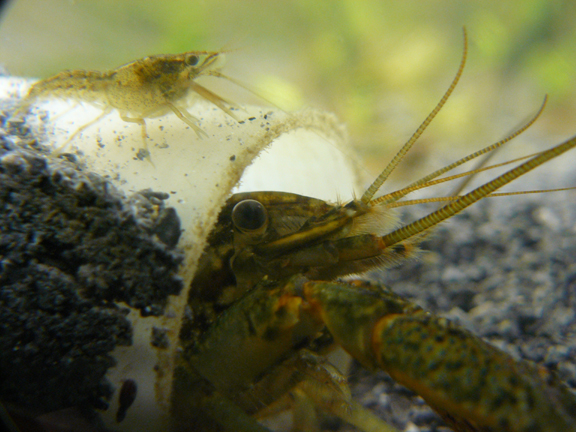
Extra hiding places help a lot — PVC pipe segments work well in a community tank, and reduce territorial stress, especially once crayfish start pairing off to breed.
Molting
Like shrimp and crabs, marbled crayfish grow by molting — crawling entirely out of their old shell. It starts when a crayfish of any size falls onto its side; the whole process usually takes 1 to 5 minutes; the body, eyes, and legs work free of the old shell, and with a final quick movement the crayfish pops free of the old legs and tail. What's left behind looks like a small carcass, and the crayfish typically eats it.
They're vulnerable right after a molt, while the new shell hardens, and need somewhere to hide. Older, larger crayfish sometimes don't survive the process — it can be a real shock to their system, and they can die mid-molt or shortly after. If a claw or leg gets damaged while the new shell is still soft, it can heal at an odd angle until the next molt corrects it.
Reproduction and colony growth
Every marbled crayfish is female, and none of them need a partner to reproduce — they reproduce parthenogenetically. They reach adult size quickly, typically 8 to 12 cm, at which point they're able to breed. Each female can carry 400 to 1,000 eggs per brood, with a gestation period of 22 to 42 days. Younger adults produce smaller broods; brood sizes increase with age.
New babies grow quickly enough to have babies of their own within 5 to 6 months, so colony numbers can increase exponentially, often twice a year. Mothers don't eat their young, and cannibalism is rare even with everyone sharing a tank — though juveniles do sometimes fight over territory or food, occasionally losing a claw or leg in the process. Lost limbs regrow during a later molt.
Growth rates vary even within the same clutch. Interestingly, it's often the smaller "runts" of a clutch that carry eggs first, not the fastest growers.
Everything on this page reflects personal, hands-on experience keeping this species — not the results of formal academic research.