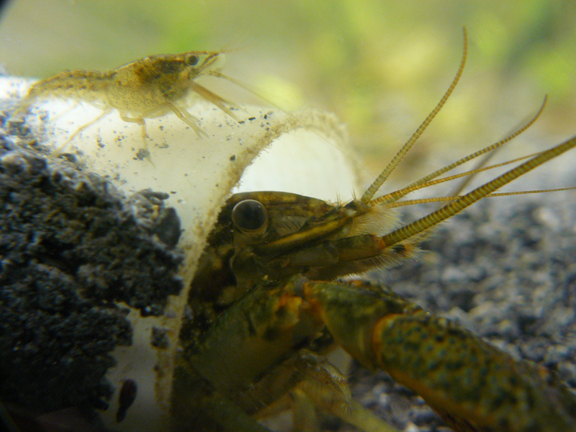
Marmorkrebs · Procambarus virginalis
Use As Feeders
Marbled crayfish make great feeders for aquarium animals, and work well frozen as fishing bait.
Feeding aggressive fish
Because they grow through such a wide range of sizes, marbled crayfish suit a lot of aggressive aquarium fish, freshwater and marine alike — cichlids, lionfish, moray eels, and other predators that do well on a live-food diet, along with some amphibians and reptiles.
Fishing bait
The same range of sizes appeals to anglers targeting bass, crappie, catfish, trout, and redfish. As a freshwater species, live marbled crayfish also work as saltwater bait — they won't survive more than a couple of hours in salt water, which keeps them from becoming an ecosystem problem there.
The one thing to watch: never release leftover live crays into lakes or streams. Since this species reproduces on its own, a single escapee can start a whole population, and they're tougher than we once thought: released marbled crayfish have established wild populations in Europe and Madagascar, including lakes in Germany where they survive winter ice. One small lake near Heidelberg holds an estimated 23,000 adults. Use frozen crays for freshwater fishing, never live ones. For the same reason, raising this species in outdoor ground-level ponds isn't a good idea; rain overflow and birds both create a path into natural waterways.
Raising your own for bait
We've tried buckets and styrofoam boxes, and heard of people using horse troughs, but an aquarium gives the best, most consistent yield of babies — and bigger is better. Some fishermen dedicate one or two 55+ gallon tanks in a garage setup just for raising bait crays. The same setup covered in Cray Care applies here — undergravel filtration, lava rock, an outside canister filter, and stacked PVC hides. It's low-maintenance once it's running: new babies arrive every 5 to 7 weeks once a batch reaches about 6 months old, so within a few months to a year you'll have an ongoing supply. Whatever you raise for bait should be dead and frozen before use, not live.
Human food?
Marbled crayfish are farmed, sold in markets, and eaten in large numbers in Madagascar, where they spread quickly after first appearing around 2005. No U.S. agency has evaluated them as a food species, so we can't speak to their safety as food.
Legal status
State rules for marbled crayfish vary and keep changing. For the current state-by-state list and the proposed federal listing, see Legal status and responsible keeping on the home page.
We're no longer offering marbled crayfish ourselves — see the Ordering page for more on that. The Cray Care section covers most of the practical questions that used to come up directly.
Everything on this page reflects personal, hands-on experience — not the results of formal academic research.