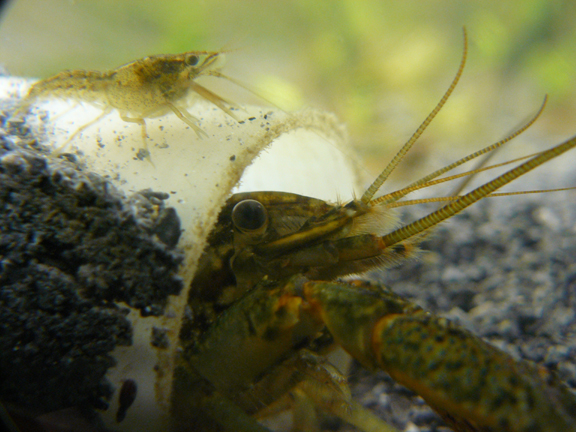
Marmorkrebs · Procambarus
Experiments
Over the years of keeping marbled crayfish, we ran a few experiments purely for our own edification. We're not a degreed biologist — just 50 years in the aquarium hobby and a wide range of hands-on experience. Take this for what it's worth.
Temperature tolerance
North Texas gives us a wide range of temperature extremes to work with. In 2008, we set up a 10-gallon and a 20-gallon tank in the garage, added marbled crays to each, and ran them on the same feeding schedule as our indoor tanks — filtered, but with no heater, over the course of a full year.
That summer ran typically brutal: outdoor thermometers topped out at 120°F, including in the shade, and the garage ran even hotter from days of heat buildup. Water temperature stayed above 100°F for weeks at a stretch. Every cray survived. They didn't reproduce, and activity slowed considerably, but the extreme heat didn't kill them. Once fall and spring arrived, reproduction and activity both picked back up.
That same winter brought freezes, snow, and ice. With no heater running, we lost a couple of crays, but most survived. Activity and feeding slowed to a crawl, reproduction stopped entirely, and water temperature dropped into the 30s — at one point the 10-gallon even had ice crystals on the surface. The animals still made it through.
That year told us marbled crays could plausibly survive temperatures found in a lake, given they survived a shallow 10-gallon tank. Shipping was a different story, though — live animals in sealed bags inside a small box had roughly a 50/50 survival rate, particularly in summer, since warehouses and trucks are rarely temperature-controlled and a bag with limited water and oxygen can effectively boil in transit. Only one Texas-based shipper ever bothered refrigerating the box between transit legs, and those shipments consistently survived. Winter shipping to colder states usually went fine, except on the coldest days, when the odds dropped back to roughly 50/50 for the same reason — unheated warehouses and trucks. Overnight shipping helped, but its cost climbed with gas prices to the point many buyers simply couldn't justify it, which is part of why we eventually limited sales to local, in-person pickup.
The blue marbled crayfish
Blue marbled crayfish get advertised for sale fairly often. Since every marbled crayfish is a clone — identical DNA, no exceptions — and since every individual already carries some blue and green in its coloring (especially in the claws and legs as it ages), it's worth understanding what's actually going on. Diet can cause a temporary color shift, the same way it does in many miniature shrimp species. Color-enhancing foods containing astaxanthin and spirulina can shift some individuals toward a genuinely striking blue — anywhere from baby blue to sapphire to blue-green. It's a real effect, but it's diet-driven and individual, not a separate blue variety of the animal.
The Oscar trial
In one 55-gallon tank, set up with a substrate of large white marble rock, we kept a marbled cray colony that had been running four years straight — old adults, young ones, babies, and pregnant females all together, with PVC tubes for the pregnant ones. Like most cray colonies, it was overrun. We had a tiger oscar we'd raised from a baby specifically to eat marbled crays — it had gotten picky enough to refuse goldfish and minnows entirely. We moved that oscar into the cray tank to see what would happen in something closer to a natural lake scenario.
It took about six weeks for the oscar to eat every visible cray. We kept it in the tank another three months, watching it occasionally bite into the marble substrate to root out anything still hiding. Eventually there was nothing left. We stirred the substrate twice a week alongside regular water changes until we couldn't find a single cray of any size, including tiny babies, and watched the tank daily to confirm it.
Once we were satisfied the tank was empty, we gave the oscar to someone with a much larger tank, and kept watching. A week of nothing. Then, at roughly two and a half weeks after the oscar left, tiny cray babies started emerging from under the substrate — cautious at first, poking out to check for danger and food. They'd apparently been surviving on detritus under the substrate the entire time, despite our stirring and cleaning while the oscar was still there; whatever scraps were left were enough to feed newborns, even while anything larger kept getting eaten.
Six to eight weeks later, that same tank was fully repopulated — adults, juveniles, babies, and pregnant females again. These animals are survivors under real pressure.
What this suggests about "invasive species" concerns
This species is native to North America, part of the broader Procambarus group. That means if it did establish somewhere in the wild here, it would be competing with closely related native crayfish for food and shelter — not moving into an empty niche. At the same time, a wiped-out population being able to recover quickly cuts both ways: it also means a steady food resource for lake fish, turtles, and other predators in that ecosystem.
Our own take is that this animal would likely settle into the existing balance of North American lakes and streams about as much as any other Procambarus crayfish already does — not create some new hazard. We think wildlife agencies sometimes over-apply the "invasive species" label reflexively, when in truth most of the animal kingdom got where it is today by migrating from somewhere else at some point.
Everything on this page reflects personal, hands-on experience — not the results of formal academic research.