Marmorkrebs · Procambarus
The strangest crayfish you will ever keep
This is the first website ever published about the marbled crayfish, online since 2007. It is the only crayfish in existence — and one of very few animals of any kind — that truly clones itself. A marbled crayfish does not need a mate to have babies.
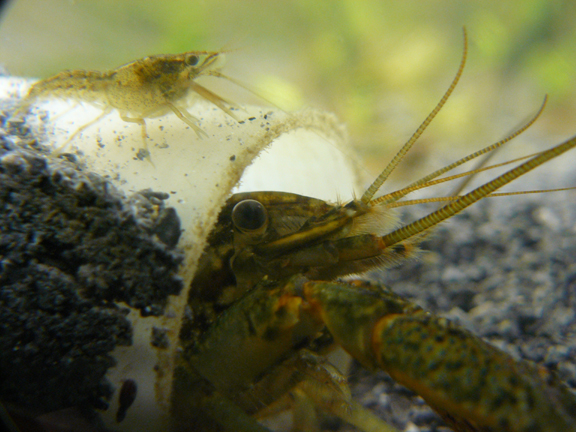
The animal was first noticed in the 1990s in a German aquarium shop, and has no known natural origin. Some enthusiasts believe it is an offshoot of the Procambarus genus, though that has never been established as fact, and academic naming has been contested ever since. What's unmistakable is the animal itself: a marbled brown pattern identical from individual to individual, deep blue legs, and hints of red and green in the claws as they mature. Diet can shift these colors further — feed green algae tablets and the whole animal takes on a green cast; feed foods rich in astaxanthin and it turns cherry red.
Reproduction without males
Every marbled crayfish is female, and none of them need a partner. They reproduce parthenogenetically — the eggs develop unfertilized, and every hatchling is a genetic duplicate of its mother. When a female is carrying eggs, she's said to be "berried," since the strands of eggs resemble clusters of berries.
They reach adult size quickly, usually 8 to 12 cm in an aquarium, and can begin reproducing about 5 to 7 months after they're born. Each female carries 400 to 1,000 eggs per brood, with gestation running 22 to 42 days. Younger adults produce smaller broods; the numbers climb as they age.
Like other crayfish, they grow by molting — crawling out of their old shell, then eating it. Two habits set them apart, though: mothers do not eat their young, and adults will share a tank with very little cannibalism, though juveniles do occasionally overpower a sibling in a power play. Because they grow and multiply fast, bigger tanks are always better than small ones. They do well in a community tank with smaller fish as long as the babies have places to hide.
Diet
Mostly vegetarian — they'll eat most live aquarium plants, particularly Anacharis and Cabomba, along with bloodworms and finely chopped raw tuna mixed into a vegetarian base. They're also very effective at clearing out aquarium snails. In my experience, unlike many other crayfish species, they won't chase and eat aquarium fish.
Tank mates and using them as feeders
This is a good species for a community tank and hardy enough for beginners. They tend to leave livebearers, tetras, and freshwater Caridina shrimp alone. Their babies are a different story — a treat for nearly any fish, and cichlids in particular are relentless about hunting them at any size.
That's exactly why many keepers raise a separate colony purely as feeders: for aggressive fish like African cichlids, Oscars, piranhas, and arowanas, for marine carnivores like lionfish and groupers, for reptile and amphibian diets, and as bait for sport fishing, especially saltwater. Since a single individual can found a colony, an unlimited supply takes only a few months to establish.
A note on fakes: some sellers pass off similar-looking crayfish as marbled crayfish at suspiciously low prices. The imitations will chase and eat tank fish, which true Marmorkrebs do not do — and obviously, they cannot clone themselves. This species is still uncommon, so be wary of anyone selling it cheaply.
Legal status and shipping
Marbled crayfish are legal to keep in most of the United States, with the exception of Nevada and, more recently, Oregon. Always check your own state's illegal-species list before acquiring one. We do not ship outside the USA.
You'll also find alarmist British press coverage online, warning that this species threatens European ecosystems and may carry a virus harmful to native crayfish. US biologists tend to downplay these claims, and no outbreak has ever been documented. Worth knowing about if you go looking, worth taking with a grain of salt.
In aquaponics
Because they're messy by nature, marbled crayfish are genuinely useful in an aquaponics setup — their waste is an effective source of nutrients for a plant bed, and they provide a steady, self-renewing supply of feeders for edible fish like tilapia, bass, trout, and perch.
They generally shouldn't share a tank with the game fish themselves, since the fish will eat them before they can multiply. The better setup is a dedicated crayfish tank, with that tank's water routed to feed the plant bed. Start at 40 gallons and go up from there. Full setup notes, including filtration, are on the gardening page, and design plans for compact apartment-sized systems are at AquaponicsTexas.com.
Genetic research
Because every marbled crayfish is genetically identical to every other, medical and genetic researchers have taken a strong interest in them. A few starting points:
Read the original article
My article Owning Clones in Aquariums and Aquaponic Systems was published in Tropical Fish Hobbyist in March 2009, and is still online at the magazine.
Availability
We were never a commercial fishery or breeding operation — these have always been personal pets, occasionally re-homed to fellow hobbyists, researchers, classrooms, and aquaponics enthusiasts. Due to personal circumstances, we're no longer keeping or offering marbled crayfish ourselves. This site now exists purely as a care reference for anyone keeping — or considering — this species. See the Ordering page for more on current availability.
Available for classroom talks & lab consulting
This site's early work led to contact with genetics departments at Harvard and other universities, and later with K–12 biology teachers. That expertise is still available — Zoom presentations, in-person talks, and lab advisory work for schools and universities alike.
The care section covers most of the questions we used to hear directly, and you can read what other keepers have said about their crayfish on the testimonials page.